
Citrus County Court Records After a Jail Arrest
When someone is arrested and booked in Citrus County, the case does not become a court record right away. The arresting agency sends its paperwork forward, and the State Attorney for the Fifth Judicial Circuit reviews it. The prosecutor then files formal charges, declines, or amends what the officer wrote. Only when charges are filed does the clerk open a case, and that case is the court record people search for after an arrest.
It helps to keep the two sides apart. The booking and custody side, including the arrest report and bond, is covered on the jail inmate records page, and booking photos are on the jail roster mugshots page. The court records after the arrest are the charges, dockets, hearings, and dispositions the clerk maintains. This page focuses on that court file: how to find it, how to read the charges, and what each status means.
The clerk's felony division does the assembling. After a felony arrest, it receives the initial paperwork from the sheriff's office and builds the official court file from the arrest documents and any release form. Copies go to the State Attorney for the filing decision, and to the Public Defender when one is appointed. That handoff is why the court record can trail the arrest by several days, even though the booking itself happened right after the arrest.
How to Find Citrus County Court Records After an Arrest
The court file lives in the clerk's online system, called the Secured Courts Online Record Search System, or SCORSS. It lets you search by party name, company name, case number, or citation number. Anonymous users must complete a CAPTCHA for each search, and a registered login can skip that step. The arrest and booking detail stays on the jail side, but the charges and court dates show up here once the clerk processes the filing.
- Open the Citrus Clerk SCORSS portal and choose the Party Name tab.
- Enter the defendant's last name, or switch to the Case Number tab if you have the number.
- Complete the CAPTCHA and open the matching case.
- Read the charge list, then check each charge's code, level, and current status.
The SCORSS search screen shows the available tabs and fields for a court-records search.
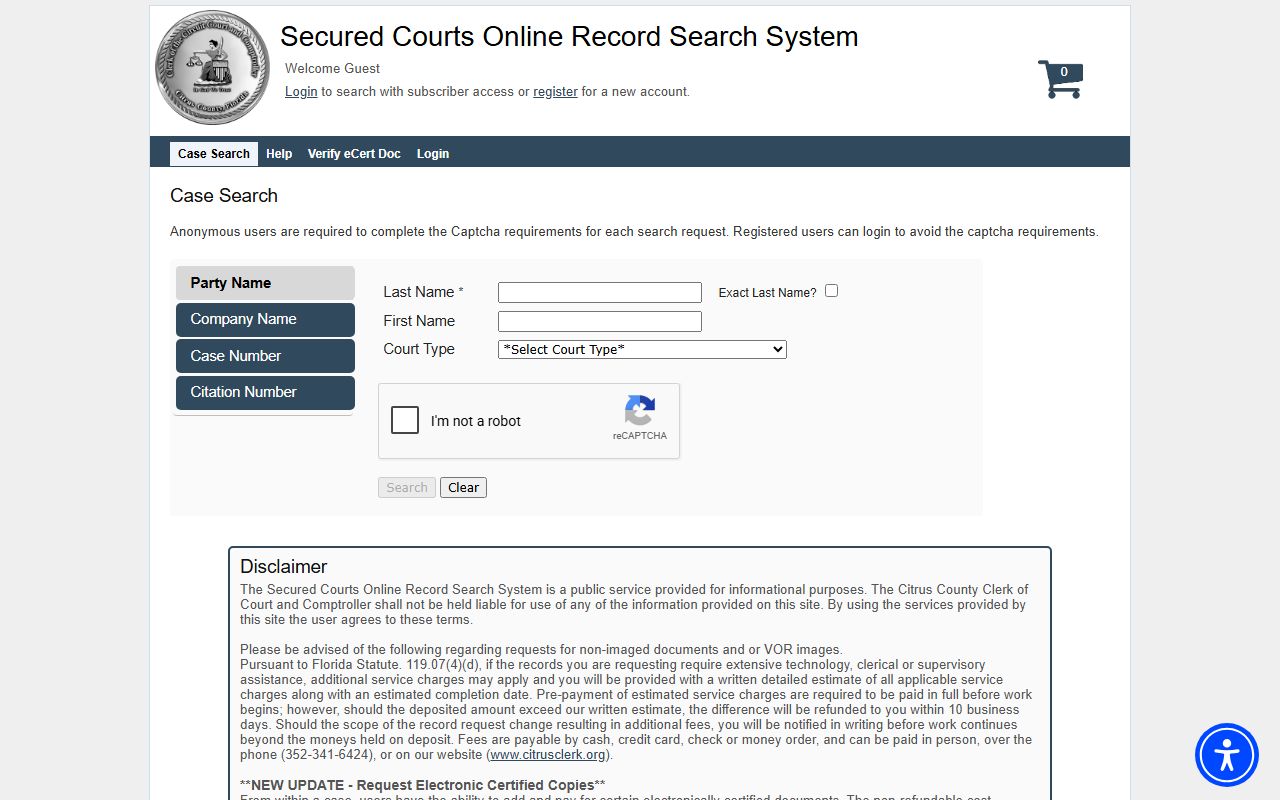
| Field Label | Type | Required | Notes |
|---|---|---|---|
| Last Name | Text | Yes for a party search | An exact-last-name checkbox is available |
| First Name | Text | No | Narrows the individual search |
| Court Type | Dropdown | No | Includes felony, misdemeanor, and criminal traffic |
| Case Number | Text | Yes on that tab | Searches an exact case number |
| CAPTCHA | Checkbox | Yes for anonymous users | Required before each search |
Filings can take a few days to post, so a brand-new arrest may not appear in the court system right away. For records that are not online, the clerk offers a JustFOIA public-records portal.
How Charges Get Filed After an Arrest: Complaint, Information, and Indictment
From the arrest forward, the charge record begins when a charging document is filed. Booking happens at the jail first. Then the prosecutor decides how to charge, and Florida uses three main documents. A complaint is common for lower-level cases, an information is the State Attorney's filing for many felonies, and an indictment comes from a grand jury for the most serious cases.
| Complaint | Information | Indictment | |
|---|---|---|---|
| Filed By | Officer / Prosecutor | State Attorney | Grand Jury |
| Common For | Misdemeanors | Many felonies | Serious felonies |
| Starts | The case | The case | The case |
The State Attorney for the Fifth Judicial Circuit, currently Bill Gladson, prosecutes cases across Citrus, Hernando, Lake, Marion, and Sumter Counties. The office page explains the prosecutor's role and the counties it serves.
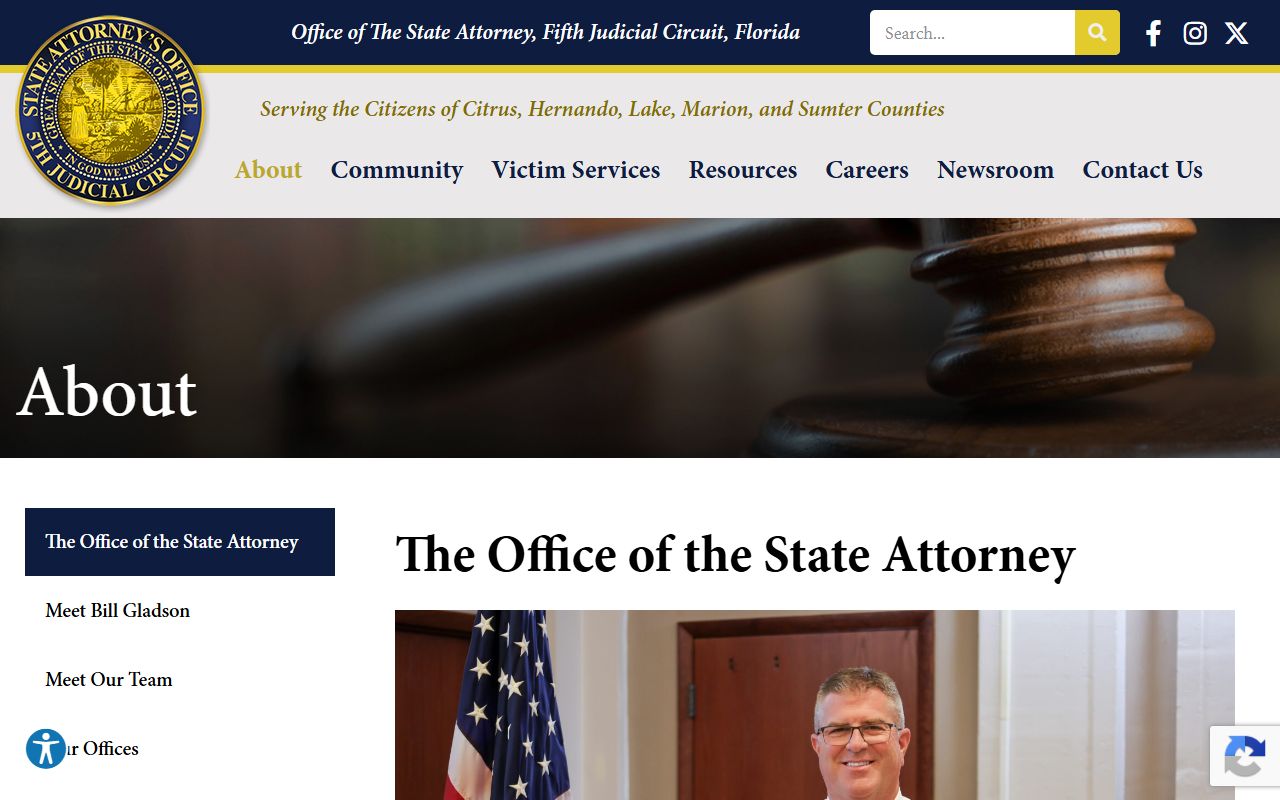
You can read the office's own description on the State Attorney's about page. The booking charge an officer writes is not always the charge the prosecutor finally files.
Charge Status and What It Means
Charges shift as a case moves. The prosecutor can amend, reduce, add, or drop them, and a judge can dismiss them. That is why the booking charge on the recent-arrest report often differs from what shows in the court file weeks later. The terms below come up constantly in a Citrus County case docket.
| Status | What It Means |
|---|---|
| Pending | The charge or case is still open and moving through court |
| Amended / Reduced | The charge was changed or lowered from the original filing |
| Dismissed | The court or prosecution ended the charge |
| Nolle Prosequi | The prosecutor formally declined to pursue the charge |
A disposition is the final outcome, such as a plea, verdict, dismissal, or sentence. Florida also allows a withhold of adjudication, where a judge may not formally enter a conviction even after a plea, though a record of the case still exists.
Bond and Release After an Arrest
Bond is set early. For most felony arrests, the defendant goes before a judge by video within 24 hours for a first appearance, where the judge addresses bond and the right to counsel. Many felonies are bondable under the approved bail schedule. Even with a bond amount listed, a hold or detainer from another agency can keep a person in custody, so a posted bond figure is not a promise of release.
| Bond Type | How It Works |
|---|---|
| Cash Bond | Posted directly; after a case, the clerk may apply it to court costs and refund the balance, generally within ten business days |
| Surety Bond | Posted through a licensed bail agent; the premium paid to the bondsman is not refundable |
| PR / Own Recognizance | Release on a written promise to appear, with no cash posted |
| No-Bond Hold | No release until a court order, often because another legal hold controls |
Cash-bond refunds and balances are clerk matters under Florida law, and the clerk's criminal division handles those questions. Florida Statutes § 907.041 governs when a defendant may be detained or released before trial.
Release does not end a defendant's duties. Once formal charges are filed, the clerk mails a notice of arraignment or status conference, usually set 30 to 45 days out. That notice goes to the address given at arrest and lists the case number, the event, and the date and location. A person who bonds out still has to watch for that mail and check SCORSS, because a missed notice can lead to a failure to appear and a capias. If the address changes, the defendant must tell the clerk in writing.
Warrants That Lead to an Arrest
An outstanding warrant is a common path into the jail. When a warrant is served, the booking can show up in the sheriff's recent-arrest report, and the arrest type may read as a county or out-of-jurisdiction warrant. Checking for an active warrant before that point is harder than people expect.
Since October 1, 2022, the clerk does not show active warrants, capiases, or orders for arrest on its website, under Florida Rule of Judicial Administration 2.420(c)(6). The clerk's office also says it cannot give out warrant or capias details by phone. A safer approach is to review the most recent court order in SCORSS, contact a defense attorney or probation officer, and never rely on a third-party warrant site. If a person failed to appear, a judge may have issued a capias, and counsel can file a motion to recall it.
Charges vs. Convictions
An arrest and a charge are accusations, not proof of guilt. A conviction comes only after a plea or a verdict. Both the charge and the conviction are public court records, but they sit at very different stages of a case.
| Charge | Conviction | |
|---|---|---|
| Stage | Accusation | Verdict or plea |
| Burden of Proof | Probable cause | Beyond a reasonable doubt |
| Public Record | Yes | Yes |
Sealed vs. Expunged Arrest Records
Florida lets eligible people clear a record after a dismissal or an eligible outcome. Sealing hides the record from public view, while expunction goes further and treats the record as if it were destroyed. Both run through a court order, and the Florida Department of Law Enforcement handles the criminal-history side of the process.
| Sealed | Expunged | |
|---|---|---|
| Visibility | Hidden from public view | Treated as if it never existed |
| Law Enforcement | Limited access | Very limited access |
| Florida Statute | § 943.059 | § 943.0585 |
Eligibility is narrow and fact-specific, so this is an area where a licensed attorney matters. The sheriff directs sealing and expunging questions to the Florida Department of Law Enforcement rather than handling them locally.
Background Check Considerations
There is a real difference between a casual court-record lookup and a regulated background check. Court records are public, but using them to decide on a job, an apartment, credit, or insurance falls under the Fair Credit Reporting Act, which has its own rules and approved providers.
Important: This site is not a consumer reporting agency under the FCRA, and nothing here may be used for employment, housing, credit, or other FCRA-covered screening.
Restricted Court Records After an Arrest in Citrus County
Not every record is open. Juvenile cases, sealed and expunged matters, and active warrants are kept from public view. Florida public-records law also exempts active criminal investigative and intelligence information, so an open case can have parts that are withheld. A charge that was dismissed still leaves a court record unless it is later sealed or expunged. When SCORSS shows nothing, the case may simply be too new, restricted by rule, or filed in another county, so an empty result is not proof that no case exists.