
The Citrus County Inmate Population
Almost everyone in the Citrus County inmate population sits in a single building. That building is the Citrus County Detention Facility in Lecanto. It is run under contract by CoreCivic, not by the Citrus County Sheriff's Office. The facility has held people for the county for nearly 30 years, according to a CoreCivic facility article published April 12, 2024. The population is mixed. It includes county residents awaiting trial, people serving short county sentences, detainees held for the U.S. Marshals Service, and sentenced offenders from the U.S. Virgin Islands.
The count moves with the courts. Arrests push it up. Bond hearings, dropped charges, and transfers to the state prison system pull it back down. The Florida Department of Corrections (FDC) tracks the average daily population at the jail in monthly reports, so the public can see how the Citrus County inmate population changes month to month even though no live headcount is posted online.
CoreCivic publishes an overview of the jail, its customer base, and its leadership. You can read the official CoreCivic Citrus County Detention Facility page for the operator's own description.
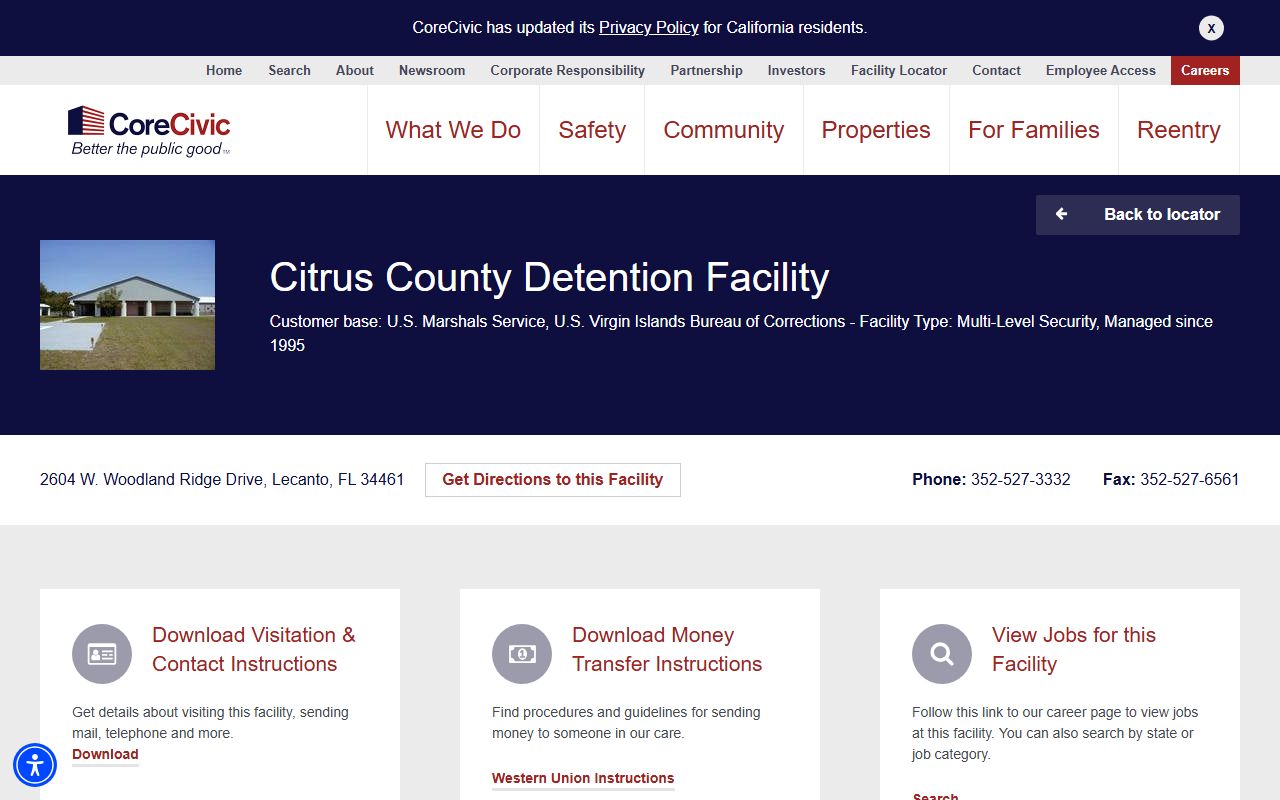
That page lists the address, phone, warden, and the agencies the facility serves, which is why the jail holds more than just local arrestees.
Citrus County Inmate Population Statistics
The hard numbers come from two sources. CoreCivic and a 2025 federal securities filing set the size of the jail. The Florida Department of Corrections sets the average daily population through its monthly county jail reports. The jail is rated for 760 beds. Its most recent reported average daily population was in the high 600s.
| Measure | Figure | Source / Year |
|---|---|---|
| Average daily population | 686 | FDC county jail report, November 2024 |
| Rated / bed capacity | 760 | CoreCivic; CoreCivic SEC Form 10-K, 2025 |
| South Building beds | 400 | CoreCivic PREA audit, 2017 |
| North Building beds | 360 | CoreCivic PREA audit, 2017 |
| Incarceration rate | 4.1 per 1,000 residents | FDC county jail report, November 2024 |
The Florida public records statute is what keeps these figures open to the public. CoreCivic and FDC publish them rather than treat them as private business data.
Citrus County Inmate Population Trends
The average daily population has climbed over the past two years. It dipped to 584 in mid-2023, then rose steadily through 2024. The Florida Department of Corrections publishes a county jail report most months, and those reports show the trend clearly. The incarceration rate held near 4.0 to 4.1 per 1,000 residents because the county's own population also grew during the same stretch.
| Report | Average Daily Population | Notes |
|---|---|---|
| February 2023 | 642 | Rate 4.1 per 1,000; county population 158,009 |
| June 2023 | 584 | Lowest point in the 2023 reports found |
| December 2023 | 656 | Rate 4.0 per 1,000; county population 162,240 |
| April 2024 | 669 | County share of the state jail total was 1.29% |
| November 2024 | 686 | County population 166,151; rate 4.1 per 1,000 |
You can pull the monthly figures yourself from the Florida Department of Corrections offender network and its published county detention reports.
Note: the average daily population is a monthly average, not a live count of who is in the jail today.
Who Makes Up the Citrus County Inmate Population
The jail does not publish a public breakdown by sex, race, or charge level. What the official record does show is the custody mix, meaning which agency a person is held for. A PREA audit and CoreCivic's own pages spell that mix out, even though they do not attach a headcount to each group.
- Pre-trial and sentenced county inmates - local residents awaiting court or serving short county sentences.
- U.S. Marshals Service detainees - federal pre-trial and sentenced people held under a federal contract.
- U.S. Virgin Islands offenders - sentenced people sent to Citrus under a separate government agreement.
- Other-agency holds - CoreCivic also lists reporting contacts for ICE detainees, so immigration holds can appear too.
Because the split by local versus federal custody is not published, treat the average daily population as the whole pie, not just the county slice.
Citrus County Jail Capacity and Overcrowding
The jail has stayed under its rated capacity in the official reports reviewed. With 760 beds and a November 2024 average of 686, the facility ran at roughly 90% of design capacity for that month. Earlier in 2023 it sat lower, near 77% in June 2023. The two named buildings carry the load together. The South Building opened in 1992 with 400 beds across four pie-shaped units. The North Building opened for occupancy in 2007 and adds 360 beds across six pods.
No public lawsuit, consent decree, or overcrowding order specific to this jail turned up in official sources during research. The numbers point to a facility that is busy but not over its bed count, though a late-2024 average in the high 600s leaves a thinner margin for housing and classification than the jail had a year earlier.
Laws Governing the Citrus County Inmate Population
Florida law is why jail data is open and why the facility must meet basic standards. Public records law forces custodians to release nonexempt records. A separate statute sets minimum standards for county and city detention facilities. Pretrial detention and release rules decide who can be held before trial and who can bond out. Each one shapes the population and what the public can see about it.
Key Statutes:
Florida Statutes § 119.07 - records custodians must let the public inspect and copy nonexempt records, and may charge set copy and service fees.
Florida Statutes § 951.23 - authorizes the standards and rules that county and municipal detention facilities like this jail must follow.
Florida Statutes § 907.041 - governs pretrial detention and release, so it decides who stays in the population before trial.
Florida has no separate state law that forces agencies to report jail deaths to the state, according to an FDLE implementation plan, so the county does not run a public jail-death dashboard.
Citrus County and the State Prison Population
People sentenced to state prison leave the county count. Once a Citrus County defendant draws a Florida prison sentence, paperwork routes the person into the Florida Department of Corrections, and they no longer belong to the jail's average daily population. No state prison sits inside Citrus County, so a sentenced felon will be moved elsewhere in the state system. That is why a name can vanish from local arrest data and reappear in the state locator weeks later.
The FDC Inmate Population Information Search covers felony offenders sentenced to state prison. It does not include county jail inmates or county probationers, which is a common source of confusion.
How to Search the Citrus County Inmate Population
There is no fielded "type a name and search" roster on the sheriff's website. The closest local tool is the Recent Arrest page, which posts a report of arrests from the last 10 days. To confirm whether someone is still in the jail, you call the facility. The steps below cover both the recent-arrest check and the custody confirmation.
Start with a full name, and a date of arrest if you have one.
- Open the CCSO Recent Arrest page and click through to the arrests-and-charges report.
- Use your browser's find tool to scan the report for the person's last name.
- Read the entry for the arrest number, date, charge, and bond, but remember it shows an arrest, not current custody.
- Call the Citrus County Detention Facility at 352-527-3332 to confirm whether the person is still held.
- If the person was sentenced to state prison, search the Florida Department of Corrections locator instead.
The official recent-arrest screen explains the 10-day window and links the current report.
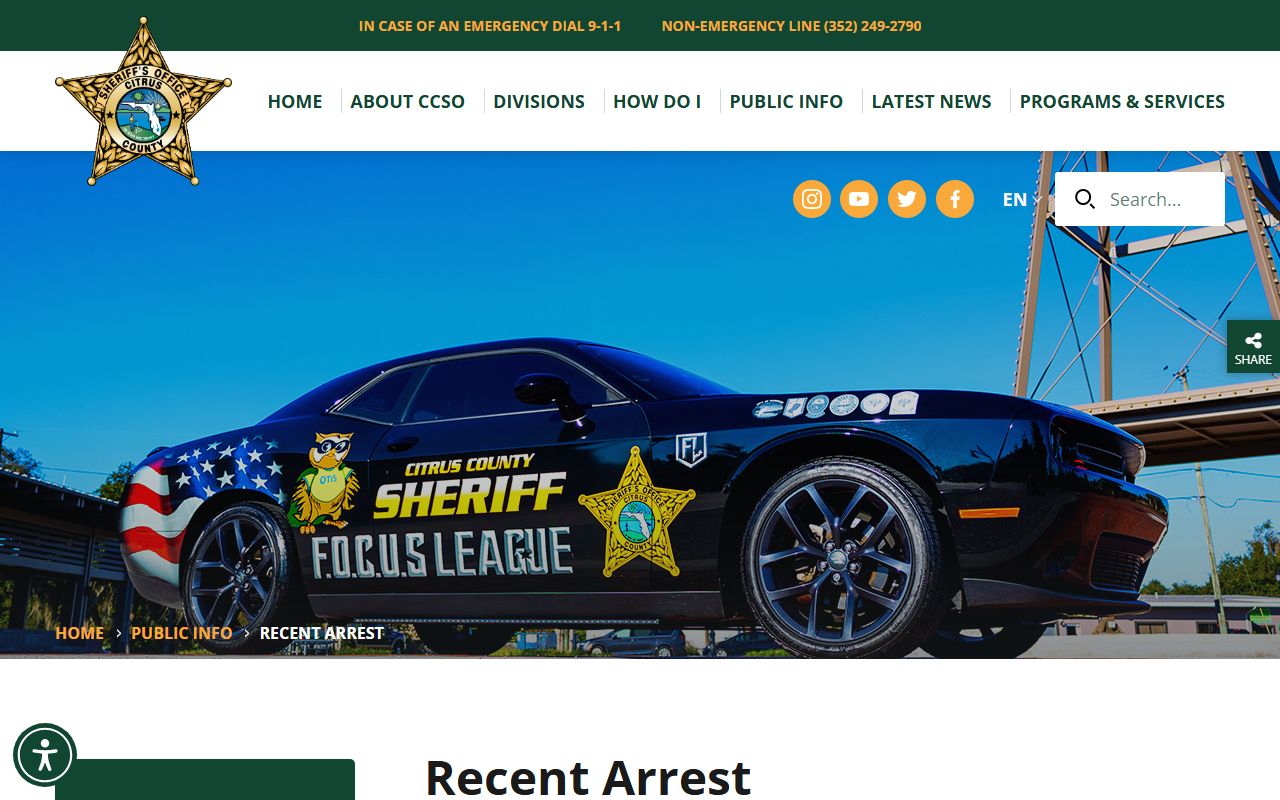
Because it is a report and not a live roster, treat anything older than a few days as a lead to verify by phone, not as proof of custody.
Current Inmate Lookup in Citrus County
For a fielded search by name or number, the state locator is the real form. The county side stays a recent-arrest report plus a phone call, since the sheriff does not run the jail and posts no live roster. The Florida Department of Corrections search below is the one true search box in this chain, and it covers people already sentenced to state prison.
| Field Label | Type | Required | Notes |
|---|---|---|---|
| Last Name | Text | One field needed | Matches names that begin with the letters typed |
| First Name | Text | One field needed | Same begins-with matching |
| DC Number | Text | One field needed | Six characters, all numbers or one letter plus five numbers |
| Search aliases? | Checkbox | No | Adds alias names to the search |
| Show only offenders with photos | Checkbox | No | Limits results to records that have a photo |
For the county jail itself, the phone line at 352-527-3332 is the fastest way to confirm a current booking, because CoreCivic holds the jail's custody records.
Past and Released Inmate Records
The sheriff keeps recent arrests online for only a short window. The Recent Arrest report covers about the last 10 days, and the office directs people to the Florida Department of Law Enforcement for records older than 30 days. So the local online trail for a past inmate is short by design.
For older records, you have a few routes. You can file a public-records request with the sheriff for an arrest or crime report. You can request jail custody records from CoreCivic, since that company runs the facility. You can search the court case in the clerk's system for charges and outcomes. Each office holds a different piece, and none of them keeps a single lifetime "inmate profile" the way many people expect.
What a Citrus County Inmate Record Shows
The county's online record is the recent-arrest report, and it lists a set of fixed columns. Some entries show a booking photo, while others read "Photo None." It does not show housing, a court date, or live release status. Those come from the jail, the clerk, or a phone call.
| Field | What It Shows |
|---|---|
| Photo | Booking photo when available; some entries show no image |
| Name | The arrested person's name |
| AR Number | Arrest report number, such as AR26-000570 |
| Date | The arrest date |
| Arrest Type | How the arrest happened, such as a county or out-of-jurisdiction warrant |
| Offense | The statute code and charge description |
| Bond | The bond amount, which can be zero or a set figure |
A few terms come up over and over when people read these records. The short glossary below keeps them straight.
- Pretrial detainee
- Someone held before conviction while charges are pending.
- Sentenced offender
- Someone serving a sentence after a court disposition.
- Detainer or hold
- A request from another agency that can block release even when bond is set.
- Writ of bodily attachment
- A civil court order, often tied to support cases, that can land a person in custody.
County Jail vs. State Prison: Where to Look
The biggest mistake in any inmate search is checking the wrong system. The county jail holds pre-trial people and short sentences. The state prison system holds sentenced felons. They use different records, run by different agencies, and a name in one will often not appear in the other.
| County Jail | State Prison (DOC) | |
|---|---|---|
| Who Is Held | Pre-trial plus short sentences | Sentenced felons |
| Run By | CoreCivic, under county contract | Florida Department of Corrections (FDC) |
| Where to Look | Recent-arrest report plus a phone call | State inmate locator |
| Stays Listed | About 10 days in the arrest report | Through the sentence, refreshed weekly |
State and Federal Inmate Search
Three more locators cover the people the county roster cannot. The Florida Department of Corrections handles sentenced state prisoners. The federal Bureau of Prisons handles federal inmates. ICE runs its own detainee locator for immigration custody. Because this jail holds people for the U.S. Marshals Service, the federal options matter here more than at a purely local lockup.
The state offender network lists every database you can search and what each one covers.
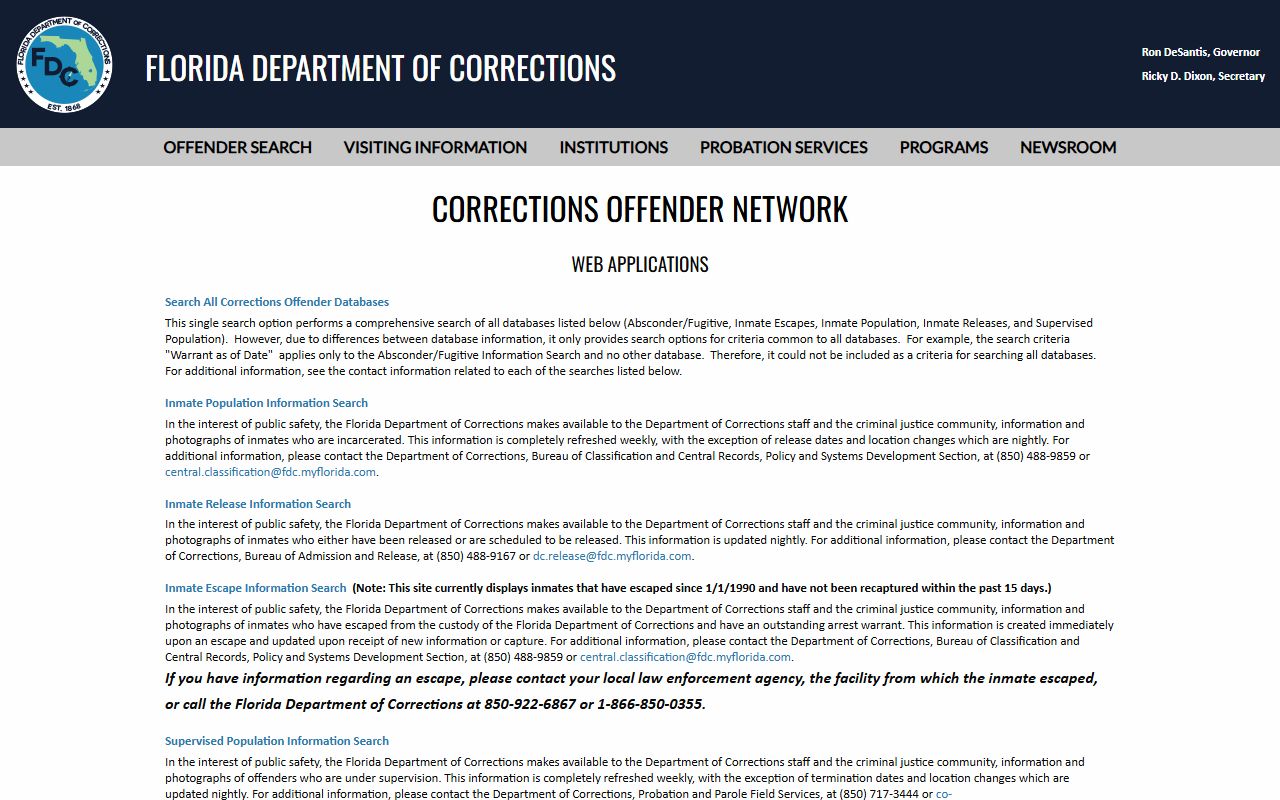
From there you can reach the federal Bureau of Prisons locator for federal custody, the ICE detainee locator for immigration holds, and the Florida VINELink service for custody notifications.
Citrus County Detention Facilities
The county map is simple. One facility holds the entire local inmate population, and it serves county, federal, and out-of-state custody under one roof. There is no separate city jail, work-release center, state prison, or federal prison physically in the county.
- Citrus County Detention Facility - the 760-bed CoreCivic jail in Lecanto holding county pre-trial and sentenced inmates, U.S. Marshals detainees, and U.S. Virgin Islands offenders.
Citrus County Inmate Population FAQ
How big is the Citrus County inmate population?
The jail is rated for 760 beds. Its average daily population was 686 in the November 2024 Florida Department of Corrections county report, up from 584 in June 2023. Those figures are monthly averages, not a live count, and they include county, federal, and U.S. Virgin Islands custody held at the same facility.
How do I search the Citrus County inmate population?
Start with the sheriff's Recent Arrest report for arrests in the last 10 days. To confirm current custody, call the Citrus County Detention Facility at 352-527-3332, because CoreCivic runs the jail and the sheriff does not post a live roster. For sentenced prisoners, use the state Department of Corrections locator instead.
Why does the sheriff not run the jail?
Citrus County contracts its detention facility to CoreCivic, which has managed the jail since 1995. The sheriff handles arrests and publishes recent-arrest information, but jail custody records come from CoreCivic at 352-527-3332. That split makes Citrus different from most Florida counties, where the sheriff runs the jail.
Can I look up a released or past inmate?
Only for a short window online. The sheriff keeps recent arrests posted for about 10 days and points to the Florida Department of Law Enforcement for older records. For anything older, file a public-records request with the sheriff for arrest reports, ask CoreCivic for jail records, or search the court case in the clerk's system.